Arthur and George is a 2005 novel by English author Julian Barnes.
The novel is
inspired of the true story of the author Arthur Conan Doyle
(1859-1930) and the lawyer George Edalji (1876-1953). Edalji was the
son of a Parsi Indian vicar in the Anglican church. The family lived
in a small rural English village of Great Wyrley, and in the 1890s
they became the target of a serious campaign of harassment via
abusive anonymous letters. Their plight was not taken seriously by
the village community or the police, and they were even accused of
having written the letters themselves. The letters stopped arriving
in the late 1890s, only for the harassment to resume in the early
1900s.
In 1903 George was
convicted on dubious circumstantial evidence of having perpetrated a
series of mutilations on farm animals in Great Wyrley, ultimately
serving three years in prison. This miscarriage of justice raised
great outrage, even after Edalji’s release. The conviction meant
that Edalji lost his career as a solicitor. Eventually the case was brought to the attention of the famous author Sir Arthur Conan Doyle, most
famous as the creator of Sherlock Holmes.
Conan Doyle became
the leading figure in the campaign against Edalji’s conviction,
writing articles and letters criticizing the unjust conviction.
Thanks to his efforts and others, Edalji was pardoned of the charge
of mutilating the animals, but he was still accused of writing some
of the letters. He was thus denied compensation for his years in
prison, but was able to return to work as a solicitor. The Edalji
case was a major reason for the creation of a British court of appeal
for criminal cases.
This fascinating
story is told in Barnes’s novel. It sticks fairly close to
historical fact from what I can tell, but its depiction of the
internal thoughts and feelings of its characters are clearly the
fictional invention of the novelist. This is acceptable, as the book
doesn’t purport to be a non-fiction account.
The first part of
the novel is a parallel biography of Doyle and Edalji. Doyle rose
from humble beginnings to become a celebrated author. The novel might
have lionized Doyle, but it complicates the image of him. It takes
its time to tell the complex story of his first wife Louise Hawkins,
affectionally called Touie. In the early 1890s, she fell ill with
tuberculosis, a disease that would ultimately claim her life in 1906.
During Louise’s long illness, Doyle cared for her, but in 1897 he
also met and fell in love with Jean Leckie. He carried on a platonic
but emotional affair with Jean, trying to hide it from his wife,
ultimately marrying Leckie in 1907 after his first wife’s death.
In the novel, the
morality of Doyle’s actions fill him with doubt. He loves Jean
behind his wife’s back, but out of a sense of honour for her, he
keeps the affair platonic and does truly care for her well-being. The
novel implies that the doubts about his own conduct is why he throws
himself into the Edalji case, as a distraction and way to restore his
own sense of honour and morality. Still, it treats his views on
Edalji’s innocence as fully sincere.
Doyle's complex attitude to
his creation Sherlock Holmes is another theme. He
disliked being identified solely as the creator of Holmes, regarding
his other work such as his historical novels and his spritualist and
political activism as being more important. But being the inventor of
the brilliant detective is what gives Doyle his fame and gives his
actions in the Edalji case more weight to the general public. His
opponents also use it to dismiss him.
Edalji, of course
had a much more difficult life. A simpler book would make him just an
innocent victim, but the novel gives him a full personality, even if
the narrative correctly never leaves his complete innocence in doubt.
Edalji is depicted as as a solitary and phlegmatic person, who
neither smoked or drank or ever married.
He has a firm sense
of identity in being english, and a strong believer in the country’s
laws and rules, until his conviction is shaken by his false
conviction. Despite obviously being the victim of racist persecution,
Edalji, firmly convinced of his own englishness, personally
discounted that as an explanation for why some people strongly
disliked him.
This gives him a
point of commonality with Doyle, who was the son of two Irish
immigrants to Scotland, yet regarded himself as English. As Doyle
points out when they first meet, both him and Edalji are “unofficial
Englishmen”. And the complexities of English identity is a major
theme in the book. Edalji is the strongest believer in English laws
and rules, yet is betrayed by its legal system. And Doyle develops a
strong moral code inspired by romanticized tales of English knights
and the mythical English king Arthur with who he shares his name, a
code that is shaken by his own emotions and actions in his love
affairs.
Arthur & George
is a fine novel. The true history of Doyle and Edalji is a
fascinating story on its own, but its fictionalized telling in
Barnes’s novel is remarkable for its power. The prose is beautiful,
as is the depth and complexity of its characterization.
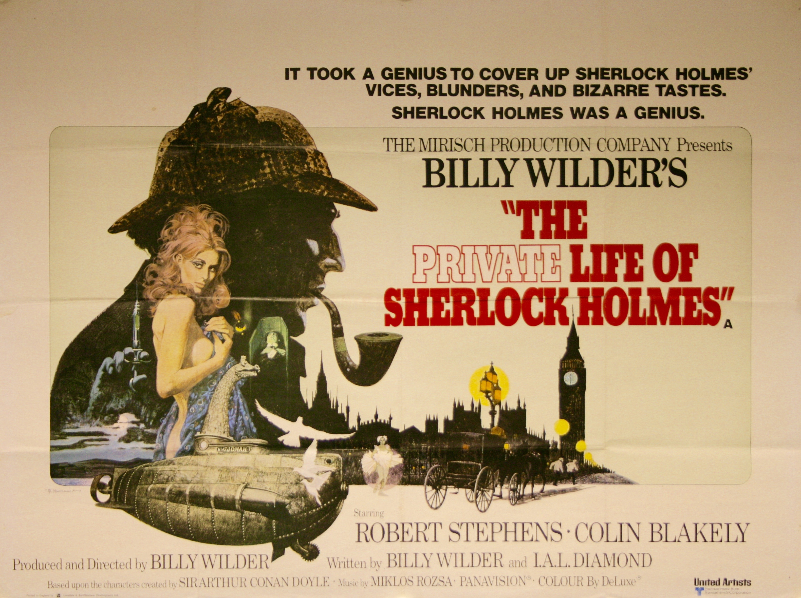
The Private Life of Sherlock Holmes is
a 1970 film, directed by Billy Wilder and written by Wilder I. A. L.
Diamond. It stars Robert Stephens as Sherlock Holmes and Colin
Blakely as Doctor Watson.
The
film features two original stories by the scriptwriters and presents
an unusual take on the character of Sherlock Holmes. It is an highly
interesting take as well, and I want to try to analyze it in depth,
so besides this being a review it is a also an analysis of the film’s
themes. I’m going to discuss the film’s plot
in detail, I suggest watching it before reading this, it is a really
good movie.
The
idea at the heart of this film is that there is a difference between
the in-universe reality of Holmes and the figure presented in the
stories told by Watson and published in the Strand Magazine. This
conceit is supported by canon, where Holmes does complain of Watson
embellishing and romanticizing the stories, and of making Holmes seem
almost infallible.
This
idea is used to both dramatic and comedic effect. There are several
jokes about the embellishments Watson has made, which include making
Holmes taller by three inches and exaggerating Holmes’s violin
playing skills.
But
this
premise develops into a serious theme: the difference between truth
and fiction, both in the form of positive ideals and cunning deceit.
Tied into this is a similar
conflict between idealism and cynicism. The
film also wants to explore the
human desire for fiction, heroes and ideals.
There is an ambiguity to
these conflicts, one almost personified in the film by Sherlock
Holmes.
Holmes
claims to resent the idealized fictions created by Watson, yet he
tries to be the hero Watson thinks him to be. Holmes complains about
being expected by the reading public to wear the deerstalker and
inverness cape, yet he still wears them.
Part
of the reason for this might be that he is in love with Watson. The
first part of the film tells a story where Holmes, in order to get
out of an embarrassing situation lies and says he and Watson are in a
romantic relationship. Watson is furious, but the viewer is left with
the suggestion that it is not just a convenient lie for Holmes.
Holmes speaks of five happy years together with Watson with an air of
sincere wistfulness that suggests that he privately wants a romantic
relationship between them to be true. So Holmes trying to be what
Watson wants him to be might be an expression of his repressed love.
Of
course, that is only part of it. Holmes also wants to be the romantic
hero, despite everything. He is an idealistic man on a probably
doomed crusade against the evils of the world.
The
plot of the film’s second story brings the idealism of Sherlock
into conflict with a
cynical reality.
Holmes investigates a case that seems like a traditional Holmes
story: a mysterious damsel in distress, Ms.
Valladon turns up unexpectedly on the doorstep of 221B and asks
Holmes to find her missing husband. Holmes investigates the case, but
is contacted by his brother
Mycroft.
Mycroft
is here
presented as a Machiavellian
and ruthless spy master for the British government. It
is extrapolated from the Mycroft of the Bruce-Partington Plans,
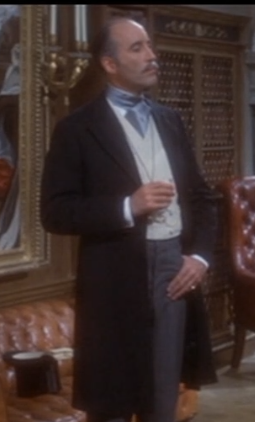
although the lean figure portrayed by Christopher Lee is very
different from the “corpulent”
canonical Mycroft.
Mycroft
represents the cynical
counterpoint to Sherlock’s idealism.
His world
is one of ruthless international espionage, technology
and warfare. There might be
a similar interplay between fiction and reality as in that of Holmes
and Watson, but here it is about the complex web of deceptions and
betrayals among spies.
Mycroft
orders Sherlock to drop the case of Ms. Valladon on the behalf of the
interests of the British government, without explaining exactly what
those interests are. Sherlock however
idealistically persists in helping Ms. Valladon and investigates the
case despite disapproval from Mycroft and
the government. The trail
leads Sherlock to Loch Ness, where the root of the mystery seems to
involve a sinister scheme involving a fake Loch Ness monster. In
another case of this film’s themes of deception vs reality,
Sherlock and Valladon pretend to be a married couple named Ashdown.
But
eventually, the person behind the sinister scheme is revealed to be
Mycroft. He is testing a submarine for the British Navy, disguising
it as the monster. Mycroft reveals that Ms. Valladon is actually a
German spy, named Ilse von Hoffmansthal. She is using Sherlock to
reveal information on the submarine. What seems at first to be a
typical Holmesian mystery story reveals itself to be a subversion.
Holmes’
deductions are correct and lead him straight to the submarine
mystery, but he fails to deduce the true nature of Ms. Valladon/von
Hoffmansthal, thus falling into her trap.
It
is especially ironic as Holmes twice in the film declares that he
does not trust women, yet he commits this mistake. His assumptions
are still sexist, but of a different kind. He just assumes Madame
Valladon is an innocent damsel in distress because that is who he
wants her to be. And that is how most his female clients in the
canonical stories are like, but Ilse is not.
The
irony in the film is present in the canon, where Holmes makes
misogynistic statements about how “women are not to be trusted”
but those words are never really borne out in his actions towards
them. And while the story in the film is original, it is similar to
his mistake with Irene Adler in A Scandal in Bohemia.
Despite
his sexism, there is little doubt in the film that Sherlock is
heroic, he is brave, intelligent and altruistic. But he is flawed in
a human way, he does not always deduce the truth. And it is suggested
that his heroism and idealism is not fit for the cynical modern era
that is coming into being during the late Victorian era when the film
takes place. It is an age of deceit he is not able to combat.
This
violent and technological
age is represented by the ruthless
Mycroft and the submarine he
is testing during the film.
It is a war machine that
unlike traditional battleships can kill entirely without warning.
Mycroft explains that
the
British submarine has
its equivalent among the German
Kaiser, who is creating zeppelins that can similarly kill without
warming, except from above.
The
looming shadow of the coming world war where technology
put to violent ends in the form of
submarines and zeppelins
would play an important role thus
hangs over the film. “The Twentieth Century Approaches” as the
title of an unrelated Russian Sherlock Holmes film with similar
themes puts
it.
But
Mycroft’s submarine is opposed by Queen Victoria itself, who orders
the submarine to be destroyed. It is highly symbolic that Queen
Victoria herself, the very namesake of an age that encompassed most
of the 19th century, is the one who literally scuttles the
submarine. Her alternative is just talking to the Kaiser, who is her
grandson. Her solution comes from an old-fashioned, almost medieval
worldview of sportsmanship and royal family ties. Victoria’s own
old-fashioned idealism, similar in kind to Sherlock’s, has a brief
victory, much to Sherlock’s amusement. It is a scene that doesn’t
make much literal sense, the historical Queen Victoria never had that
kind of power, but as comedy affirming the film’s theme, it works.
Afterwards,
having been told of Madame Valladon’s true nature, Sherlock
confronts her and leads her German spy allies into a trap and her to
be arrested. It is a highly ironic scene, where Sherlock pretends to
have figured out Von Hoffmansthal’s deception, but of course he
didn’t, Mycroft just told him. And Mycroft didn’t use Holmesian
deduction to do so either, but ordinary espionage. Through trickery
similar to what has in reality defeated him, Sherlock upholds the
legend of himself. In a silent acknowledgement of her victory,
Sherlock manages to convince Mycroft and the British government to
have Ilse exchanged for a British spiy captured by the Germans.
In
the film’s final scene, Sherlock learns in a letter from Mycroft of
Ilse being executed while spying in Japan. And that in a kind of
tribute to her experiences with Holmes, perhaps to Sherlock’s noble
but doomed idealism, she had used the name Ashdown.
The Private Life
of Sherlock Holmes is a
thematically very interesting film, as I hopefully conveyed in this
essay. It is a very well-made and enjoyable film too. The
script and direction is superb.
The complex mood of the story
is beautifully sustained, with gentle comedy with some genuinely
witty and funny moments serving an ultimately elegiac and melancholy
mood.
The
acting is excellent, with Robert Stephens in the lead role successfully conveying the variety of emotions Holmes goes through.
Colin Blakely plays a
comedic and somewhat bumbling Watson, albeit one that feels
intelligent compared to Nigel Bruce. Geneviéne Page is convincing as
the duplicitous but far from cold Ilse von Hofmansthal. And
Christopher Lee, always a commanding screen presence, is perfect for
the role of Mycroft as presented in this film. Authoritative,
intelligent and with an ever-present hint of scheming menace.
The
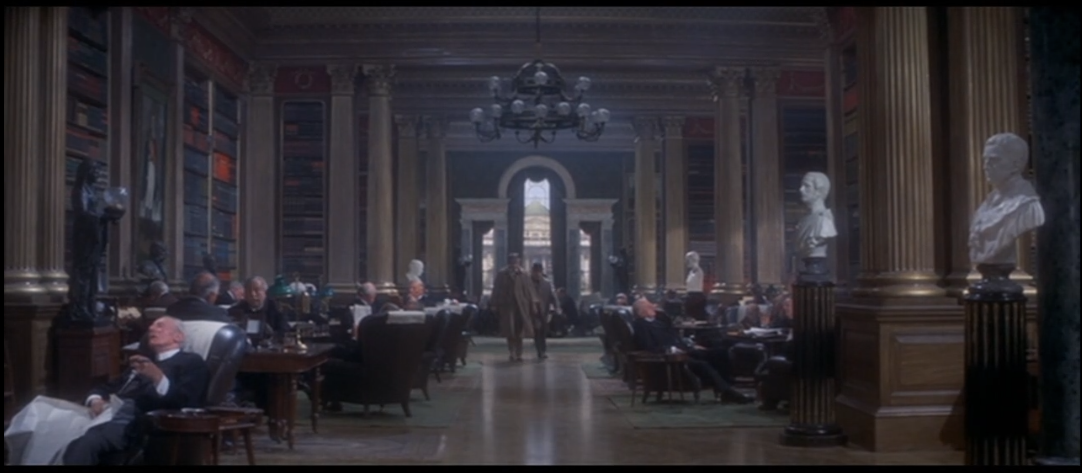
film is also beautiful to look at, with some very elaborate and
well-constructed sets and props by production designer Alexander Trauner that are very impressive. The
location shooting in Scotland at Inverness and Loch Ness makes for
some beautiful shots.
A recording of Rósza conducting an orchestral suite based on his music in the film
Miklós
Rózsa’s score is excellent and plays a big part of creating the
movie’s elegiac mood. It features his violin concerto, which
was originally a concert piece unrelated to Rósza’s film music,
plus some music composed directly for the film.
As
grand an achievement, the
film which is viewable today is, it
is sadly not what it
was originally intended to
be. The
film was originally intended
by the director Billy
Wilder to be over 3 hours
long and feature four stories. There were however cuts forced by the
studio that removed two of the segments and pared down the film to
about 2 hours.
And
none of the cut scenes survive in their entirety, with both audio and
visuals intact. Which is extremely unfortunate, as
the
cut segments sound very
interesting. One is about
Watson trying to solve a case
on a ship and coming to a wrong conclusion, proving how difficult
Holmes’s work is. The other is about Watson
constructing a fake murder mystery to occupy Holmes’s mind in order
to keep him away from cocaine.
The
cocaine is present in the film, one of the first Holmes films to
directly show him using cocaine after the death of the Hays code. But
it isn’t developed much, beyond the suggestion that Holmes’s
stated reason of the drug just relieving boredom is not entirely the
truth. He clearly takes
it at times of emotional distress, such as in the ending when
learning of Ilse’s death. And
there is also a barely developed theme of Watson worrying just as in
canon over Holmes’s cocaine use, here in the film taking the
trouble of hiding Holmes’s supply and diluting the famous
seven-per-cent solution to a five percent one.
This
lack of development
is probably due to that story segment
being cut, which is a shame. More development
of Holmes’s cocaine habit, as well as his friendship with Watson
and his worries about his friend’s drug use would be interesting.
Still, even in abridged form, The Private Life of Sherlock Holmes
remains an interesting and highly enjoyable film. There have been
more films about Sherlock Holmes than any other fictional character
besides perhaps Dracula, this is one of the best.
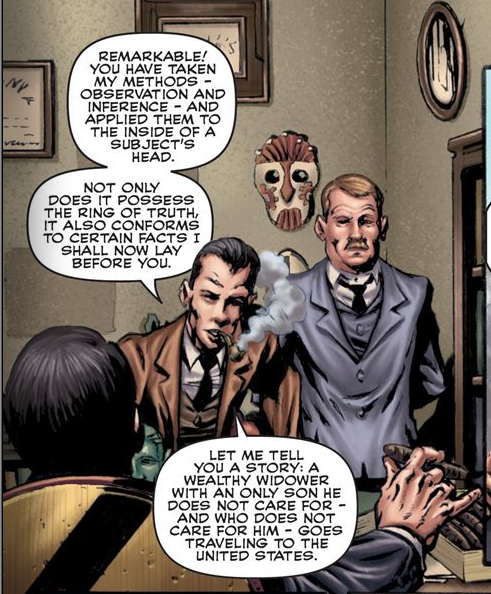
This 1974 novel by Nicholas Meyer is perhaps the most famous
Sherlock Holmes pastiche novel. It was a best-seller when released,
was partly responsible for a revival of interest in Sherlock Holmes
in the 70s, and its success has inspired the publication of many,
many more Holmes pastiche books.
It’s success and
status in the Holmes fandom has led to it being adapted at least
three times. And I’m going to talk about and review not only the novel, but
also its three adaptations which have been made over the years:
the 1976 film, the 1993 BBC Radio Drama and the 2016 comic book.
To discuss the
story and its adaptations properly, I’m going to explain the plot,
including the ending, so be warned.
The book’s take on
Holmes is revisionist. It focuses on Holmes’s use of cocaine, which
in the novel has by 1891 became an addiction that might kill him.
Professor Moriarty being an evil criminal mastermind is Holmes’
delusion, created by his compulsive use of cocaine. In reality,
Moriarty is an innocent mathematics tutor, who once taught both
Sherlock and Mycroft when they were children.
To cure Sherlock of
his addiction, which might soon turn fatal, Doctor Watson and Mycroft
Holmes lure him to Vienna, to meet Sigmund Freud, the father of
psychoanalysis. Freud is to treat and cure Holmes of his drug
addiction.
After much effort by
Holmes himself especially, Holmes is put on the part of recovery.
Then he discovers a mystery involving one of Freud’s patients, and
the game is afoot once more.
As mentioned, this
book was a huge success. And it is understandable, for it is a very
well-written book. Meyer’s imitation of Watson’s style is
successful and feels authentic. The premise is interesting and
inventive. The first part of the book, showing Holmes’ in the grips
of a terrible drug addiction, his and Doctor Watson’s valiant
efforts to help him recover is emotionally powerful. The close
friendship between Holmes and Watson is very well depicted.
The second part of
the book shows Holmes, Watson and Freud working together to solve a
mystery. It is a very good mystery and is exhilarating to read about.
The entire trio get to show their skills, and the idea of a team-up
between Holmes and Freud is used to great effect.
It culminates in an
amazing action scene with a train chase and a swordfight atop a
train. The scene may be silly, complete with a “cutting up a train
car for fuel” part straight out the Marx Brothers Go West,
but very fun.
It has high stakes,
involving a possible war in Europe, which adds to the excitement, but
it still feels grounded enough to be a fitting case for Holmes.
Despite the politics involved, it is still rooted in
personal/psychological problems (which provides a role for Freud to
make deductions of his own). Holmes is also unable to change history
through his actions, he himself notes that he has at most only
delayed a European war, which of course eventually broke out in 1914.
This helps further ground the case in reality.
Meyer’s book is a
good example of how Holmes is adapted to fit the times. Despite being
a period piece set in 1891, the novel is very much a product of the
1970s. The frank depiction of Holmes’s drug use was due to a
greater openness about drugs and their effects in culture at the
time. The depiction of Holmes as a fallible hero due to his drug use
also fit the sceptical cultural mood at the time, even if the second
half re-establishes him as a heroic figure.
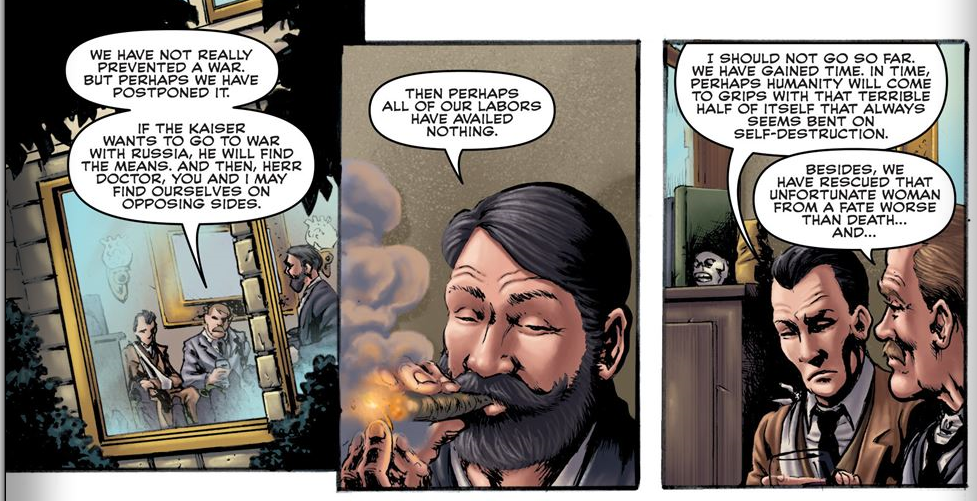
Holmes
philosophizing on war and violence in the comic book adaptation, as is
typical of the comic book, the words are pretty much verbatim from the
book.
The theme of the
second part of the book is clearly anti-war, with the backstory
involving a pacifist quaker woman trying to destroy an arms
manufacturing empire and Holmes trying to stop a war in Europe. After
the disaster of the Vietnam War, this fit the prevailing anti-war
mood in the western world perfectly.
Of course, despite
being a product of its time in these aspects, the book doesn’t feel
dated for the most time, because the time period in which it was
written mostly is expressed through themes. The 1891 time period, the
style of the novel and the characters Holmes and Watson’s feels
true to the original stories.
Holmes’s praise of Freud in the comic book adaptation, again the words are pretty much directly from the original novel.
The novel has
probably dated the most in its positive depiction of Freud and his
ideas. Freudianism was going through a period of popularity in the
1970s. Although I’m on the whole against freudian ideas, the
depiction here wasn’t that annoying to me. I must admit that the
comparisons made between Holmes’ detective work and Freud’s work
are actually quite clever. Freud’s case studies read like detective
stories after all (and are probably just as fictionalized).
Freud’s
involvement culminates in the final twist of the novel, where Freud
is able through hypnosis reveal a traumatic experience in Holmes’
childhood. His father killed his mother, due to her affair with his
tutor Professor Moriarty. And the novel presents Freud’s
predictable analysis of this uncritically: this traumatic event
explains why he became a detective and fighter of crime, why he used
cocaine, why Moriarty became a malignant figure in his delusion and
so on. It’s of course silly, although it is fitting for a novel
involving Freud and Holmes to end like this, with Freud’s theories
being applied to the great detective.
The novel was
adapted into a film directed by Herbert Ross in 1976, with a
screenplay by Meyer himself. And I have mixed feelings about it. The
novel is flawed, but the changes made for the film make it worse. The
main problem is that they changed a lot of the mystery in the
second-half. It involves an evil baron, a damsel in distress and a
train chase, but there the similarities pretty much end. The book’s
complex backstory involving the morality of weapons manufacturing and
a possible war in Europe is jettisoned.
Instead we get a
simplistic “rescue the damsel in distress” story. And it is a
racist/orientalist plot as well: An evil Ottoman Pasha wants to
kidnap a white woman for his seraglio. This is a massive change for
the worse.
The original plot
was sexist also in its “damsel in distress” nature, but it was
more interesting. The themes of weapons manufacturing, a war in
Europe and the woman Nancy Slater’s opposition to it raised
interesting themes and raised the stakes for the story. And while she
was damseled, the woman’s moral principles and intelligence was
what put that plot into motion.
The film’s plot
has none of those engaging features, and it is just boring and
clichéd. It is racist and was extremely unoriginal even back in
1976. Also, it’s a minor and underdeveloped part of the film, but
the film’s clumsy attempt to hint at a romantic relationship
between Lola and Holmes was just annoying and felt out of character
for Holmes.
Of course, the film
has its merits as well, which is why I have mixed feelings about it.
Certain aspects of the film are quite excellent. The film is very
well-made overall. The direction and cinemtography is odd sometimes
but conveys the suffering Holmes goes through well. The acting is
excellent, especially Nicol Williamson as a Holmes in a very
difficult situation. Robert Duvall’s Watson is held back by his
stuffy attempt at an english accent, but his part is decent
otherwise. Alan Arkin is a convincing and authorative Freud. Vanessa
Redgrave is underutilized as Lola Deveareaux but she is always fun to
see. We even get a bit of luxury casting with Laurence Olivier as in
the small role of Moriarty.
And for certain
stretches, the film works very well. The first half or so of the film
is excellent, and adapts the novel rather closely, with only minor
and insignificant changes. The film goes off the rails in the second
half due to substituting the strong mystery of the book with a weaker
one. But the climatic train chase is on par with the one in the book
and very fun. Ridiculous, but such an entertaining and exciting
scene. Perhaps one of my favourite action scenes in cinema, if I’m to be perfectly honest.
The film is very
uneven, and the changes made from the book generally only weaken the story, but
there is enough good things that it can be worth watching. The
climatic train scene is so fun that it makes up for the weak mystery
plot that led there.
There was also a
1993 BBC radio drama adaptation of the book. It stars Simon Callow as
Holmes, who also played the role in the “Unopened Case-book of
Sherlock Holmes”, a series of pastiche radio dramas aired on the
BBC the same year. It has almost been (unfairly) forgotten, but can
be found on the OTR Researchers Library website.
This radio version
takes some cues from the film in how it dramatizes the story, but as
is the standard for BBC Radio adaptations of literature, much more
faithful to the book and retains the mystery from it. And it is much
more stronger because of that. The acting isn’t on the level of the
film or the contemporary Clive Merrison/Michael Williams BBC Holmes
dramas, but still quite strong. Callow is a good Holmes and Ian Hogg
as Watson outdoes Duvall from the film. It is a bit rushed due to
only being 90 minutes, but is an excellent and faithful version of
the book that is a far less uneven experience than the film.
Similarly faithful
to the book is the 2015-2016 comic book adaptation, written by Scott
and David Tipton with art by Ron Joseph. The script follows the book
very faithfully. There are some minor cuts to the story to make the
story work as a 100 page comic, but no major changes. It is so
faithful that there isn’t actually anything to say about the
comic’s writing that I haven’t already said about the source
material. The art is well-done and nice, even if I’m not that
enamoured with how Joseph draws humans, but that is probably a taste
thing.